



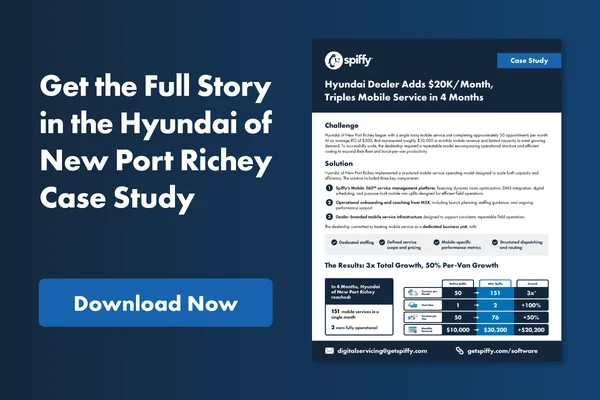
How did Hyundai of New Port Richey scale from 50 mobile services per month to 151 in just four months?
Three Lessons:
- Treat mobile as a separate business unit
- Fix productivity before adding to fleet size
- Growth must and will improve core fixed operations
The results:
- More than tripled total mobile repair order volume
- Increased per-van productivity by 50%
- Added over $20,000 in monthly mobile revenue
- Freed up 151 fixed-bay hours in one month
The numbers are impressive.
But the real story isn’t the growth.
It’s how they achieved it.
Here are the three decisions that had an impact.
Lesson 1: Treat Mobile Like a Business Unit — Not an Add-On
Hyundai of New Port Richey didn’t treat mobile as overflow capacity.
They treated it as its own operation.
Hyundai of New Port Richey implemented:
- Dedicated staffing for mobile team (service advisor and technicians)
- Clear performance metrics for mobile
- Defined mobile specific workflows
- Operational accountability across all the team members.
Mobile wasn’t “extra work” layered onto fixed ops. It had structure.
That structure enabled:
- Predictable routing
- Measurable productivity
- Clear ownership of results
When mobile has accountability, it scales.
When it’s a side project, it often fails.
Lesson 2: Productivity Matters More Than Fleet Size
Dealers who have existing mobile vehicles must address the productivity of the current fleet before adding new assets. Spiffy increases productivity by 50% or more. The standard is an average of at least 5 mobile repair orders per van across all shifts.
Hyundai of New Port Richey’s per-van productivity increased from 50 services per van to 76 services per van, a 50% increase in output per unit.

Many new dealerships think scaling mobile means adding more vehicles. Hyundai proved that efficiency drives growth faster than van expansion.
Mobile efficiency comes from dynamic routing, structured scheduling and dramatically reduced administrative friction for the management team.
These improvements increased daily stops (ROs) per van, which is what drives revenue per unit.
The result?
Higher output without proportional cost growth.
That’s scalable.
Lesson 3: Growth Must Improve the Core Operation
Mobile didn’t just increase volume.
It improved the main shop.
By completing 151 services in the field in February, the dealership generated 151 additional fixed-bay hours.
That means:
- Better allocation of technician skillsets
- More room for heavy repairs in shop
- More diagnostic capacity for the shop and mobile
- Less congestion on property
- More convenience for the customer which builds a retention moat around their service needs
Mobile does not replace the service drive. It expands a dealer’s total production capacity.
Mobile wasn’t competing with fixed operations. It strengthens fixed operations.
The Recall and Retention Multiplier
Over half of the dealership’s mobile repair orders were recalls.
They completed:
238 recalls across 9 campaigns.
They also re-engaged:
22 long-dormant customers.
Mobile became both a growth engine and a retention lever
It captured incremental maintenance.
It protected warranty relationships.
It brought customers back into the service cycle.
Mobile service created a real positive impact for their customers.
Sustainable Growth Shows Up in Customer Experience
Mobile service drives immediate and significant increases in customer satisfaction.
Hyundai of New Port Richey achieved:
- A 15-point NPS improvement
- 100% trust attribute scores
Mobile service growth is operationally executable, increases revenue, improves gross profit and creates sustainable customer satisfaction improvements.
The Big Takeaway
Hyundai of New Port Richey built a mobile operating system when they launched mobile services.
An operating system that:
- Increased per-van productivity
- Expanded total service capacity
- Protected retention
- Generated incremental revenue
- Strengthened fixed ops
This is what structured mobile growth looks like.
Mobile service only becomes transformative when it’s treated as:
- A business unit
- A production platform
- A measurable revenue engine
Hyundai of New Port Richey built the mobile operating system that produced results across many key metrics.
Posted in Digital Servicing, Case Study