


Customers will gladly pay 4x — sometimes 2,000x — to not do something themselves. Here’s the data, and what it means for anyone who sells a service.
A 16-ounce bottle of water can cost up to 2,000 times more than the tap three feet away. People buy it anyway — billions of times a year. We tend to file that under “irrational.” It isn’t. It’s one of the most powerful and predictable forces in business, and most companies still price as if it doesn’t exist.
I’ve spent more than twelve years and over four million services building a company on a single bet about human behavior: people will pay a premium to not do something themselves — or to not have to leave to get it done. I’ve never seen that bet lose.
To show how reliable it is, we mapped nine ordinary purchases. Same outcome, two ways to get it: one you do yourself, one someone does for you. The done-for-you version costs more every single time — and the gap is wider than most people would guess.
The Numbers Don't Flinch
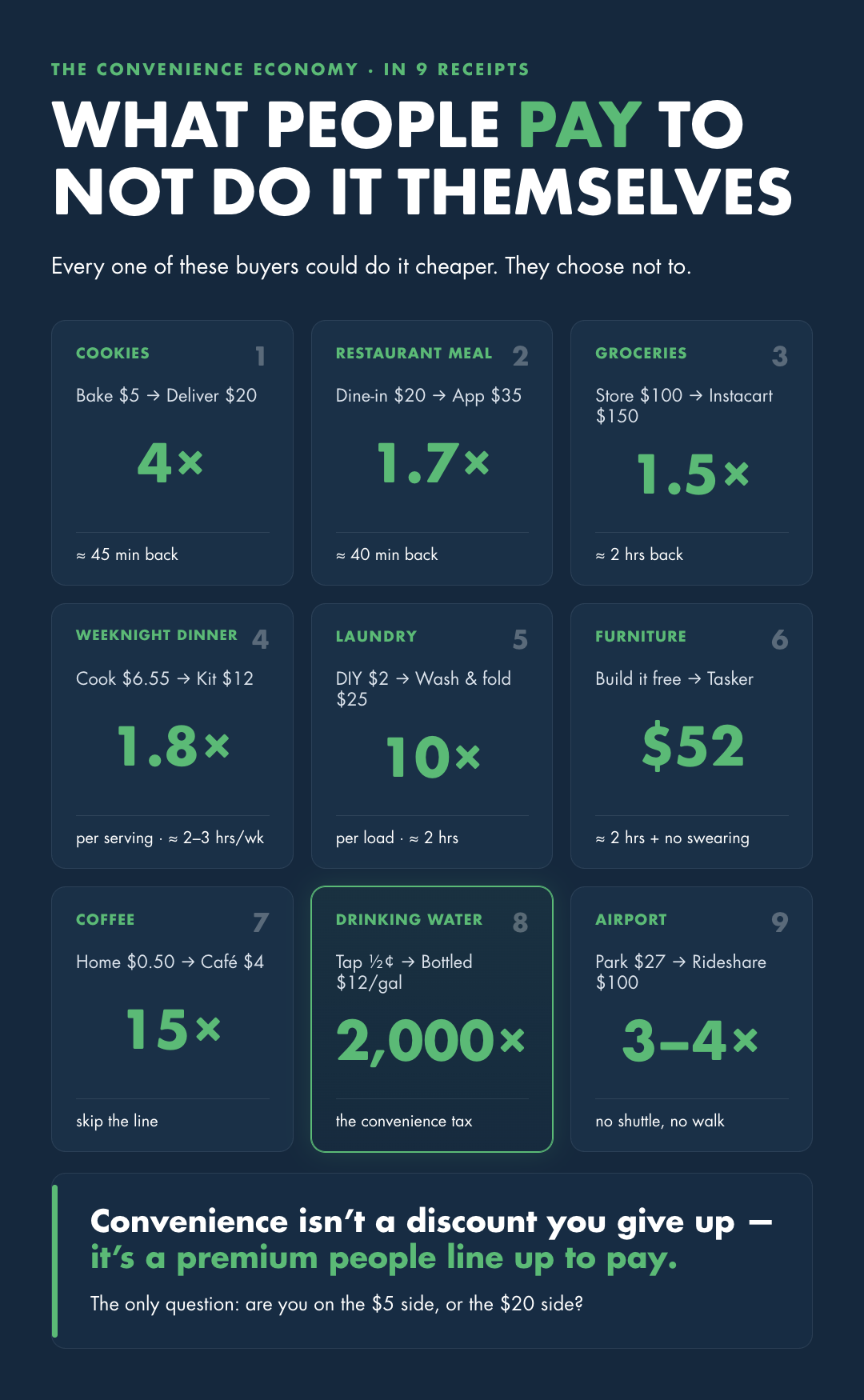
Here is the full set, cheapest premium to steepest. Note that even the “modest” gaps aren’t modest — and the ceiling is absurd.
DIY vs. done-for-you — cost and the premium people pay
| Category | Do it yourself | Done for you | Premium |
|---|---|---|---|
| Groceries | In-store $100 | Instacart ~$150 | 1.5× |
| Restaurant meal | Dine-in / pickup $20 | Delivery app ~$35 | 1.7× |
| Weeknight dinner | Cook from groceries$6.55 / serving | Meal kit~$12 / serving | 1.8× |
| Airport trip | Self-park $273-day economy | Round-trip rideshare~$100 | 3–4× |
| Cookies | Bake at home $5 | Delivered ~$20 | 4× |
| Laundry | DIY ~$2 / load | Wash-and-fold ~$25 / load | 10× |
| Coffee | Home brew ~$0.50 | Café ~$4 | Up to 15× |
| Furniture | Assemble it (free) | TaskRabbit $52+ | $0→$52 |
| Drinking water | Tap ~½¢ / gal | Bottled ~$12 / gal | Up to 2,000× |
Nobody in this data is being fooled. Every buyer knows the cheaper option exists. They reach for the expensive one on purpose — and they'll do it again tomorrow.
Convenience isn't a discount you give up. It's a premium people line up to pay.
What They're Actually Buying
They’re not buying cookies, or clean laundry, or a cup of coffee. They’re buying back their time — and paying to skip the friction. Dan Kennedy said it plainly decades ago: people don’t buy the product, they buy what it does for them. What more and more of them want it to do is simple. I don’t want to do it myself.
Time is the one thing none of us can manufacture more of. Friction is the tax we’ll quietly pay to avoid. Put those two truths together and the “irrational” bottled water makes perfect sense — it’s cold, it’s here, and it costs you nothing but money. For a lot of people, most of the time, that’s the trade they want.
The $5 Side or the $20 Side
Every industry has a $5 side and a $20 side: the business that makes the customer come to it, and the business that shows up. In automotive service — my world — this is the entire game right now.
Customers don’t skip service over price. They skip it over friction: the drive, the wait, the lost half-day, the loaner shuffle. So they defect to whoever is easier, or they simply stop coming back. The dealers and fleets winning retention today have one thing in common — they stopped asking customers to come to them. For a fleet, the math is even starker: every hour a vehicle sits in a service bay is downtime. Bring the service to the vehicle and that dead time turns back into uptime.
We built Spiffy on the $20 side on purpose — mobile service delivered to the driveway, the dealership lot, the fleet yard. Not because convenience is a nice-to-have, but because it’s what people are already paying for in every other corner of their lives. The only question worth asking about your own business is the one this data keeps asking: what friction are you removing — and are you charging for it?