



Dealerships launching mobile service often track the wrong numbers.
They measure:
- Number of vans
- Total appointments
- Total mobile revenue
But the metric that determines whether mobile is healthy — and scalable — is simpler:
Revenue per van.
If you don’t know that number, you don’t know whether your mobile operation is productive, sustainable, or ready to grow.
Let’s break down what “healthy” actually means.
Why Revenue Per Van Matters
Mobile service has fixed and semi-fixed costs:
- Technician compensation
- Vehicle depreciation or lease
- Insurance
- Fuel
- Equipment
- Technology
- Scheduling and admin support
Those costs exist whether the van completes 2 jobs per day or 6.
Revenue per van tells you:
Is this unit pulling its weight?
If the answer is unclear, expansion becomes challenging.
Start With Simple Math
Revenue per van is driven by three variables:
- Jobs per day
- Average repair order (RO)
- Working days per month
For example:
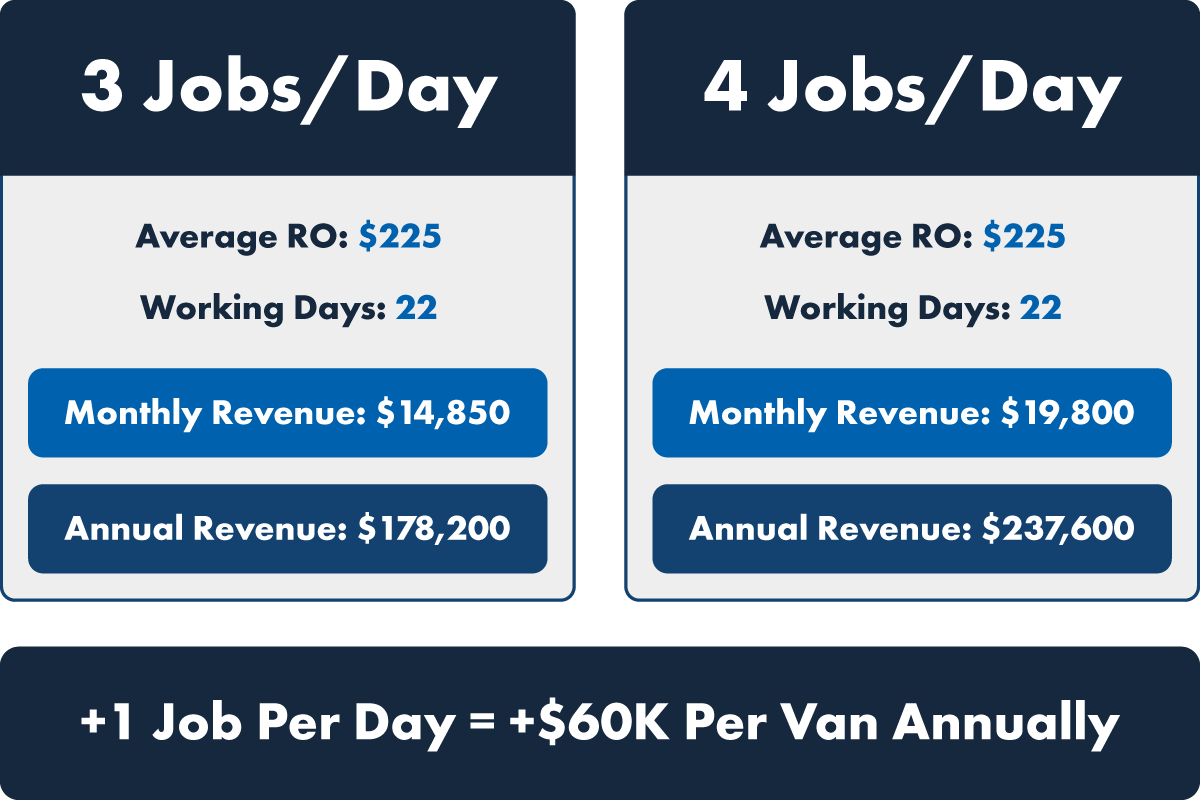
3 jobs per day
$225 average RO
22 working days
3 × $225 × 22 = $14,850 per month
Annualized: ≈ $178,200 per van
Now increase output slightly:
4 jobs per day
$225 average RO
22 working days
4 × $225 × 22 = $19,800 per month
Annualized: ≈ $237,600 per van
One additional job per day increases annual revenue per van by nearly $60,000.
That’s the power of utilization.
What “Healthy” Typically Looks Like
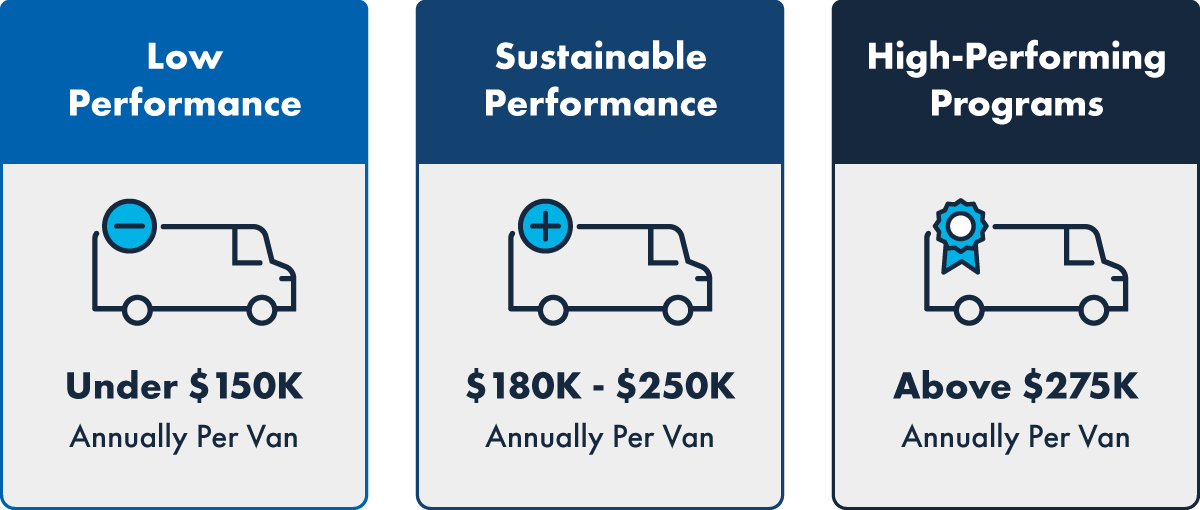
While benchmarks vary by market, healthy mobile programs often land in these ranges:
Low performance:
Under $150,000 annually per van
Usually indicates underutilization or weak scheduling discipline.
Sustainable performance:
$180,000–$250,000 annually per van
Indicates steady routing, consistent demand, and reasonable productivity.
High-performing programs:
$275,000+ annually per van
Typically reflects tight routing, strong recall capture, and disciplined scheduling.
The difference isn’t pricing.
It’s productivity.
Why Fleet Size Is the Wrong Focus
Dealers often assume scaling means adding vans.
But if one van is only generating $140,000 annually, adding a second van simply doubles underperformance.
Scaling before optimizing revenue per van increases cost faster than revenue.
Healthy programs ask:
Is each unit producing at a high level before we expand?
If the answer is no, the focus should be optimization — not expansion.
Revenue Per Van Is a Discipline Metric
This number forces clarity.
If revenue per van is stagnant, it usually means:
- Route density is weak
- Scheduling is loose
- Travel time is excessive
- Pricing is inconsistent
- Or marketing isn’t feeding enough volume
Revenue per van exposes operational softness quickly.
And that’s a good thing.
Because what gets measured gets improved.
The Break-Even Question
Every dealership should know:
What does this van need to produce to break even?
That number depends on:
- Technician pay structure
- Vehicle cost
- Insurance
- Technology
- Overhead allocation
But once you know that threshold, you gain confidence.
You stop guessing.
And you stop expanding prematurely.
The Strategic Takeaway
Revenue per van is not just a financial metric.
It’s a readiness indicator.
Before adding a second or third van, ask:
- Is the first van optimized?
- Are we hitting consistent daily stop targets?
- Would adding another van improve routing efficiency?
- Are our margins healthy?
If not, expansion multiplies inefficiency.
If yes, scaling becomes powerful.
The Bottom Line
Mobile service becomes transformative when it is:
- Structured
- Accountable
- Measured
- Disciplined
Revenue per van is the number that ties all of that together.
If you want mobile to be a profit center — not a feature — start there.
Measure it.
Improve it.
Then scale it.

Posted in Services, Digital Servicing