



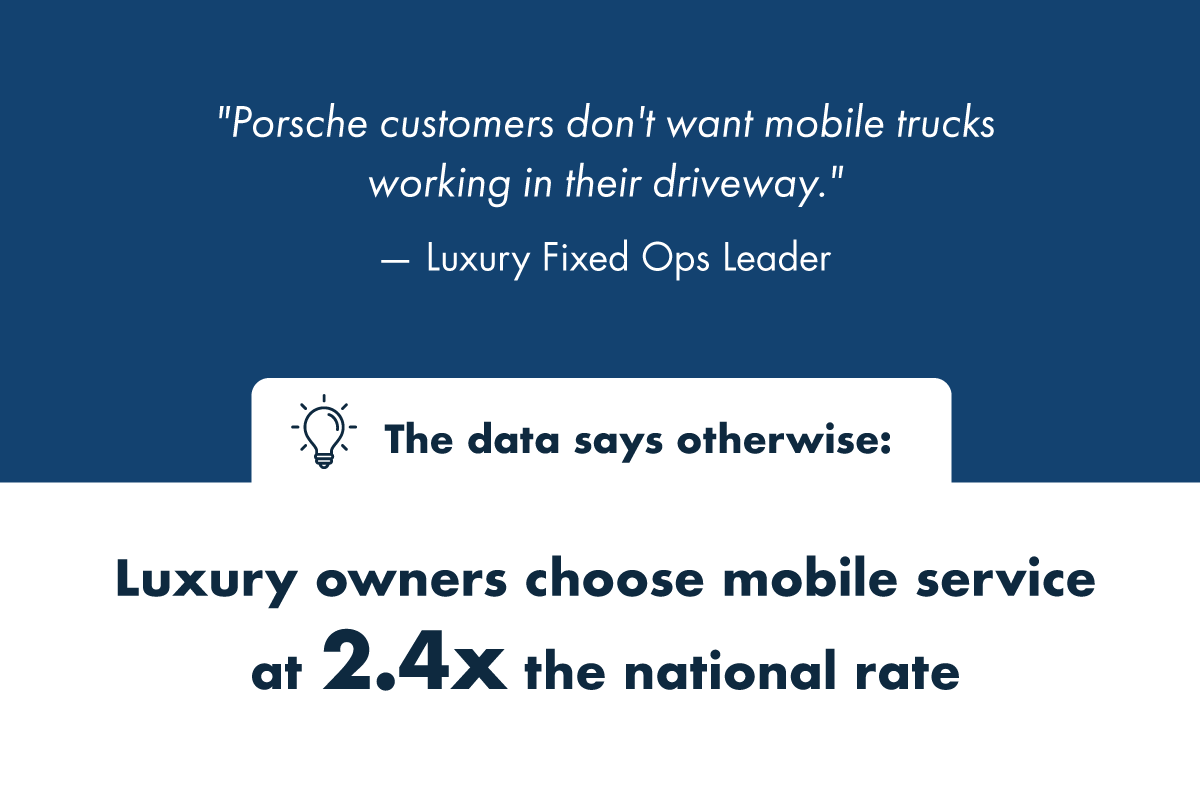
For years, a common objection has come up in conversations with luxury and premium dealers: "My customers don't want mobile techs changing oil in the driveway of their homes."
It's an understandable assumption. Luxury ownership comes with high expectations around white-glove treatment, and driveway service can sound like a step down from the dealership experience these customers are paying for.
But, the data tells a different story.
Luxury owners are choosing mobile service at more than double the national rate
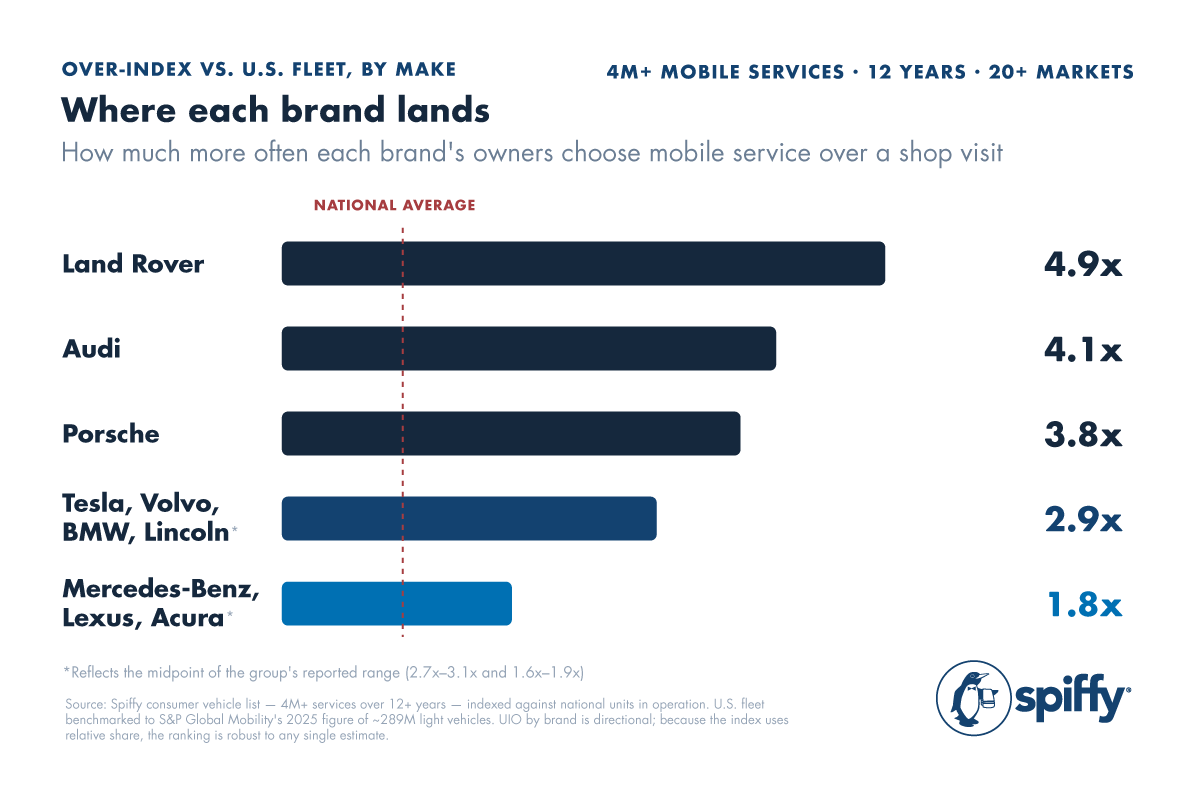
Across Spiffy's dataset of more than 4 million mobile services completed over 12 years in 20-plus markets, luxury owners choose mobile service at 2.4x the national rate. When the data is indexed against U.S. fleet composition by make, the trend holds up brand by brand, not just in aggregate.
Land Rover owners choose mobile service at nearly 5x the average based on their share of vehicles on the road. Audi and Porsche owners follow at 4.1x and 3.8x, respectively. Even the brands at the more accessible end of the luxury and premium spectrum, including Tesla, Volvo, BMW, Lincoln, Mercedes-Benz, Lexus, and Acura, still over-index against the national average.
The rankings are based on share of mobile services relative to units in operation nationally.
The objection doesn't match what owners actually do
The assumption that luxury customers want distance between themselves and mobile service gets repeated often enough that it can start to feel like fact. But when a fixed ops leader says Porsche customers don't want mobile trucks working in their driveway, and the data shows Porsche owners using mobile service at 3.8x the national average, the gap between perception and behavior becomes hard to ignore.
The conversation among dealers has already shifted
Eighteen months ago, this objection was the starting point of most conversations with luxury dealers. That's no longer where the conversation begins.
The questions dealers ask now look different: Who's actually performing the diagnostics, and is the standard the same as what happens in their shop? How does mobile service integrate with their DMS without creating a second system to manage? Can the program scale?
Those are operational questions, not adoption questions. That shift matters. It signals that the "should I offer mobile service" conversation is largely settled for this segment, and what's left is figuring out how to run the program well.
What this means for OEMs and dealers
For luxury and premium brands still treating mobile service as a lower-tier convenience, the data suggests the opposite is true. Convenience is already the expectation at this tier, not a discount on the ownership experience. The owners in the highest-indexing categories, Land Rover, Audi, and Porsche, are choosing mobile service more often than the market as a whole, not less.
The dealers and OEMs building mobile programs today aren't trying to convince luxury customers that mobile service belongs in their world. The customers already believe that. The work now is building programs with the diagnostics standards, DMS integration, and scalability that match the expectations luxury ownership already carries.
Source: Spiffy consumer vehicle data, more than 4 million services over 12-plus years, indexed against national units in operation. U.S. fleet benchmarked to S&P Global Mobility's 2025 estimate of roughly 289 million light vehicles.
FAQ
Do luxury car owners use mobile mechanic services?
Yes. Luxury vehicle owners choose mobile service at 2.4x the national rate, based on Spiffy's dataset of more than 4 million mobile services.
Which luxury car brands use mobile service the most?
Land Rover owners over-index the most at 4.9x the national average, followed by Audi at 4.1x and Porsche at 3.8x. Tesla, Volvo, BMW, and Lincoln owners use mobile service at roughly 2.9x, and Mercedes-Benz, Lexus, and Acura owners at roughly 1.8x.
Are luxury customers reluctant to have mobile technicians service their vehicle at home?
The data doesn't support that assumption. Luxury and premium owners across nearly every major brand use mobile service at a higher rate than the national average, with several brands over-indexing by 3x or more.
How is mobile service usage measured across luxury brands?
Usage is indexed against each brand's share of vehicles on the road nationally, using S&P Global Mobility's 2025 estimate of roughly 289 million light vehicles in operation. Indexing by relative share means the ranking holds up regardless of how any single brand's registration count is estimated.
Posted in Business, Digital Servicing